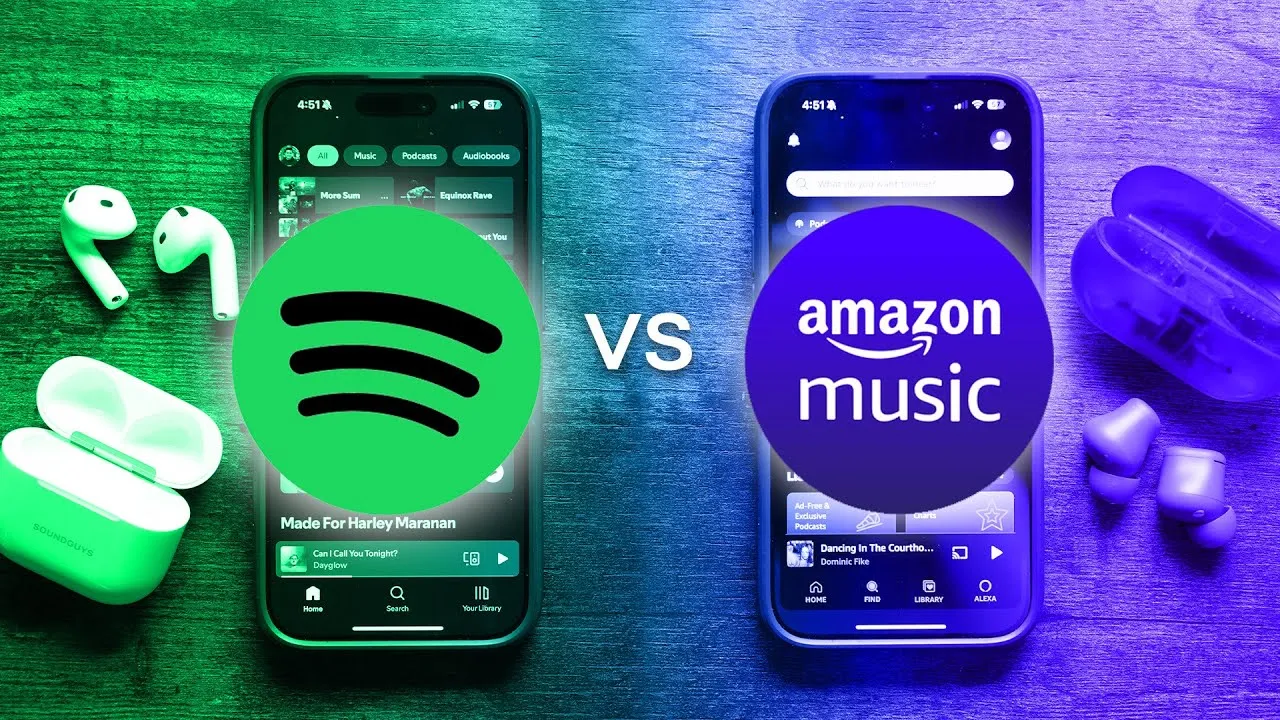
Amazon Music vs Spotify in 2026 – Which is Better?
Here is the blog post, structured with proper headings and written in a consistent blog-post style, without altering the original content or tone.
It’s 2025, and I’ve spent well over the past six months using Amazon Music and Spotify music offcial. The question I really wanted to dive into is why you would choose Amazon Music over Spotify when Spotify is so dominant. It turns out there are actually a few reasons why you would go with Amazon Music.
Amazon Music’s Advantages
Let’s take a look at Amazon Music’s advantages, starting with the least impactful and moving toward the most significant.
4. Exclusive Live Performances
Amazon has so few of these right now that it’s barely worth mentioning, but if one of your favorite artists has a performance, it could be something that sways you over to Amazon Music.
3. Ability to Purchase and Import Music
Amazon Music allows you to purchase music tracks from the secondary menu that pops up next to a song and import them into your library. The music you purchase should automatically show up in Amazon Music; however, if it doesn’t, you can download the tracks you purchased and import them for local playback. But Amazon Music doesn’t have a cloud library feature like YouTube Music or Apple Music.
2. AI Maestro Feature (Beta)
This feature is in beta at the time of recording and allows you to use an AI prompt to generate a customized playlist. You can use words or emojis in your prompt, and in my limited testing, it’s worked quite well.
1. Superior Audio Quality: Lossless and Spatial Audio
The number one, and probably the main reason you’d go with Amazon Music over Spotify, is that Amazon Music supports spatial audio music as well as high-res lossless music, importantly at no additional cost.
Spotify announced they’d be bringing high-quality music streaming to their service in February 2021 and, as of this recording, has yet to release that feature or support for the Dolby Atmos music format.
Why Audio Formats Matter
First, let’s look at lossless audio. Amazon Music Unlimited has more than 100 million songs available in HD lossless audio.
- HD songs start with 16-bit 44.1 kHz.
- Ultra HD is 24-bit with a sample rate of up to 192 kHz (you’ll need a digital-to-audio converter device, a DAC, to experience this version).
What does all of this mean to the average listener? Well, the music quality on Amazon Music is better than Spotify, though there is a debate over at what point people can really tell a difference between lossy audio, which means it’s compressed, and lossless. Keep in mind, if you use headphones with Amazon Music, most Bluetooth headphones today cannot actually play lossless audio. Some of them can over certain codecs, but most of the time, they’re going to default back to lossy when over a Bluetooth connection.
By far, the more important audio format that Amazon Music has that Spotify premium apk doesn’t is Dolby Atmos, as well as 360 Reality Audio, which is similar. They’re both spatial audio music formats, with Dolby Atmos being the more popular one.
- Unlike the stereo format, which has a right and left channel, Dolby Atmos is an object-based audio format that allows sound mixers to digitally place different parts of a music track around a virtual room.
- This causes you, as a listener, to notice things like vocal effects or instrumentation more in an Atmos mix than you necessarily would in a stereo mix.
- You’ll also find that Atmos tracks don’t sound as loud because Dolby requires Atmos mixes to be at -8 LKFS, which is why they’ll sound about 10 dB quieter than their stereo counterparts.
- This causes Atmos tracks to often have more headroom as well as a greater dynamic range, meaning there’s a greater difference between the loudest part of the track and the quietest part of the track.
- Typically, stereo mixes nowadays are mixed to sound as loud as possible. Not all Atmos mixes sound good, though. Early versions had a tendency to drown out vocals with instrumentation, but more recent mixes are quite good.
Do note, though, not all Amazon Music devices will play Atmos. For example, the Amazon Music app on Mac doesn’t play the Atmos format, though their phone app does. When you’re listening to headphones, certain speakers also don’t support the Atmos format. Right now, though, my Sonos Era 300 does, which is a speaker I’ve reviewed that was built for spatial audio.
The Music Library and Content Comparison
Both Amazon Music and Spotify apk claim to have over 100 million songs, meaning you should easily find all the songs you want to listen to and then some, no matter which platform you choose.
Podcasts and Audiobooks
Besides music, both platforms offer a wide selection of podcasts. However, Spotify also offers access to over 375,000 audiobooks.
- If you have a Premium subscription, you get up to 15 hours of audiobook listening time for free every month, or you can buy audiobooks individually.
- From a content perspective, Spotify and Amazon Music seem to be pretty close, but Spotify’s inclusion of audiobooks gives it a clear advantage for listeners who want them.
Navigating the Switch: A Quick Note
Before we look at Spotify’s advantages, if you’re thinking about switching, doing that manually can be a real pain. But thankfully, there are solutions out there that can help with this, like Tune My Music.
With its powerful transfer tool, Tune My Music lets you seamlessly transfer your music between services, working across all of the major music platforms, including Spotify and Amazon Music. You can easily move playlists, albums, and your entire music library. Tune My Music’s matching technology finds songs across platforms, so nothing gets left behind. I was able to move more than 2,000 songs from one service to another with minimal “no matches found.”
You can also set it to sync new playlist additions automatically, keep your playlists up to date across multiple services, and share playlists with friends regardless of what music service they use.
Spotify’s Advantages
Alright, now let’s talk about Spotify. What gives it the edge?
6. Superior Customized Playlists and Discovery
Spotify has a larger number of customized playlists compared to Amazon Music. While Amazon Music has some, Spotify has way more with playlists like the Time Capsule Mix (which takes you back to your teenage years), different artist, decade, genre, and mood mixes, all created based on your taste profile, and the Repeat Rewind playlist (a playlist of your favorite music that you were listening to in the past).
You can also use Spotify’s Blend feature to create customized playlists based on you and a friend or spouse. Additionally, Spotify gives you the ability to exclude certain content from your taste profile.
5. Simplified “Like” System
With Amazon Music, liking a song or album won’t automatically add it to your library; that’s a separate action. On Spotify, hitting the plus button does both of those actions—liking and adding it to your library.
4. Jam Session Feature
This feature allows your friends and family to add songs to your Spotify queue in real time, and they don’t have to be paying members of Spotify Premium to use it. Amazon Music doesn’t have anything like that or even collaborative playlists.
3. AI DJ Feature
Spotify’s AI DJ is great for those times when you want to listen to something but aren’t really sure what to listen to. The DJ will typically start with something you’ve been listening to recently, then reach back into your listening history, and introduce you to new stuff along the way.
2. Network Effects (Dominance)
According to Statista, Spotify still dominates the industry with a 30% share globally, more than double Amazon Music’s 11.1% share. This matters because it’s more likely your friends and family are using Spotify, making it easier to share music with them, have shared playlists, and start Jam Sessions.
1. Spotify Connect
This feature allows you to stream your Spotify music to any device that integrates with Spotify. Not only that, it lets you control whatever music you have playing on a device. For example, if I’m playing Spotify through my Sonos speakers, I can open up the Spotify app on my MacBook Air and control what’s playing in real time.
Amazon Music’s app does support a wide variety of casting like Spotify, including Google’s Chromecast, Amazon’s own casting technology, and Apple’s AirPlay, but it can’t pick up from where you left off on any device.
🔍 Search and Recommendation Features
On Spotify, the answer is a lot of features. Spotify has been around for a long time and has really refined its recommendation algorithms, packing them into features that I use pretty much daily.
- Autogenerated Playlists: This includes Discover Weekly and Daylist.
- AI-Centric Features: This includes DJX (automatically cues up music based on your listening habits) and the AI playlist feature (create playlists using prompts).
- Convenience: You can create radio stations based on your favorite songs/artists, or search by lyrics if you forget the title of a track.
How does Amazon Music compare? I have to say that Amazon’s search and recommendation features are just a little underwhelming.
- Stations: Amazon Music offers stations that automatically generate a queue of songs based on your favorite artist, songs, playlists, and albums.
- Alexa Integration: With Alexa, you can queue up your favorite songs or have it select songs for you based on what you’re feeling (e.g., “play songs for the beach”). In theory, this sounds cool, but I didn’t find that Alexa did a good job of queuing up songs that I particularly liked; I wish it gave more personalized options.
- UI Issue: I also really don’t like the fact that I cannot access my playlist directly from the home screen on Amazon Music. I have to go all the way to my library and then open the playlist again just to see what’s inside.
In this case, I’ve got to give the win to Spotify.
💰 Pricing Comparison
If you don’t want to pay, both Amazon Music and Spotify will let you listen to their catalog for free, though with limitations.
| Feature | Spotify (Free) | Amazon Music (Free) |
| Library Access | Full music and podcast library | Full music and podcast library |
| Skips | Unlimited | Limited |
| Playback | Can’t play songs in any order | Shuffle-only playback |
| Ads | Yes | Yes |
| Offline Listening | No | No |
| Better Option | Spotify (for unlimited skips) |
If you are willing to pay, this is where the story gets a little more complicated.
Subscription Costs
Both platforms have base individual plans coming in at $9.99 a month (just like most other streaming services), with family plans at $14.99 and student plans at $5.99.
| Plan Type | Spotify | Amazon Music Unlimited | Amazon Music Unlimited (for Prime Members) |
| Individual | $10.99/month | $9.99/month | $7.99/month |
| Family | $16.99/month | $16.99/month | N/A |
| Student | $5.99/month | $5.99/month | N/A |
| Echo Only | N/A | $5.99/month | N/A |
Note: The prices cited in the source material varied slightly, reflecting potential minor price increases for some plans on both services.
Amazon Prime Music Tier
If you’re an Amazon Prime member, you automatically get access to Amazon Music’s Prime tier with your $99 annual fee for Prime. This means you can enjoy the entire collection of songs and podcasts ad-free and even download content for offline playback.
However, there are still some limitations with the Prime tier:
- You don’t have unlimited skips unless you’re listening to songs that are in what Amazon calls an “all-access playlist.”
- You don’t have access to HD and Ultra HD streaming quality.
- You don’t get access to spatial audio tracks.
Amazon Music’s subscription model is cheaper than Spotify if you’re a Prime member, and you get more bang for your buck (lossless audio and spatial audio) if you go with the Unlimited tier.
Which Platform is Better?
Both services have free tiers and podcasts, plus Spotify has audiobooks integrated in. Both have pretty good recommendation algorithms, though I’d still give the edge to Spotify. Also, the Spotify app is a bit more responsive than Amazon Music’s. In my experience, I’ve run into bugs with both liking songs as well as a lag when adding something to my library on Amazon Music.
My Recommendation
Unless you want higher quality music or spatial audio music, or the ability to purchase music within the same ecosystem as your music service, I think Spotify is going to be the better choice between the two.
I choose Spotify because:
- It’s supported on more devices.
- It has better-customized playlists.
- It has better sharing features.
- It has Spotify Connect.
- Spotify’s recommendation algorithms are just far superior than what you get on Amazon Music.
I will be sticking with Spotify. Don’t get me wrong, I did enjoy my time with Amazon Music, and I even love the fact that it offers a higher-quality and more immersive listening experience than Spotify. But honestly, since I mostly use wireless headphones and earbuds to listen to music, I know that I’m not really going to benefit from the lossless audio files when I’m streaming songs. I just can’t get enough of features like Discover Weekly and Daylist. These features that make it so easy to find new songs and create playlists are what’s making it really difficult for me to switch out of Spotify to another platform.

I’m martably passionate music enthusiast and researcher behind all the content you find here at spotifyapk.
As the site’s owner and publisher, my mission is simple: to provide clear, informative, and useful guides on the ever-evolving world of digital music platforms. Follow the journey and connect on Instagram: @martably! This site is dedicated to informational purposes, fueled purely by a love for music.